
Executive Summary
Unbound Solutions, a B2B service provider, faced significant growth limitations due to a minimalist one-page website that failed to articulate their value proposition or capture high-intent leads. By restructuring the site architecture into a comprehensive, user-centric multi-page experience—while strictly adhering to existing brand guidelines—we increased site engagement by 42% and improved lead-to-opportunity conversion rates to 3.8% within six months. This transformation successfully positioned Unbound Solutions as a high-authority provider in their industry, moving beyond a “brochure-style” site to a functional sales engine.
The Challenge
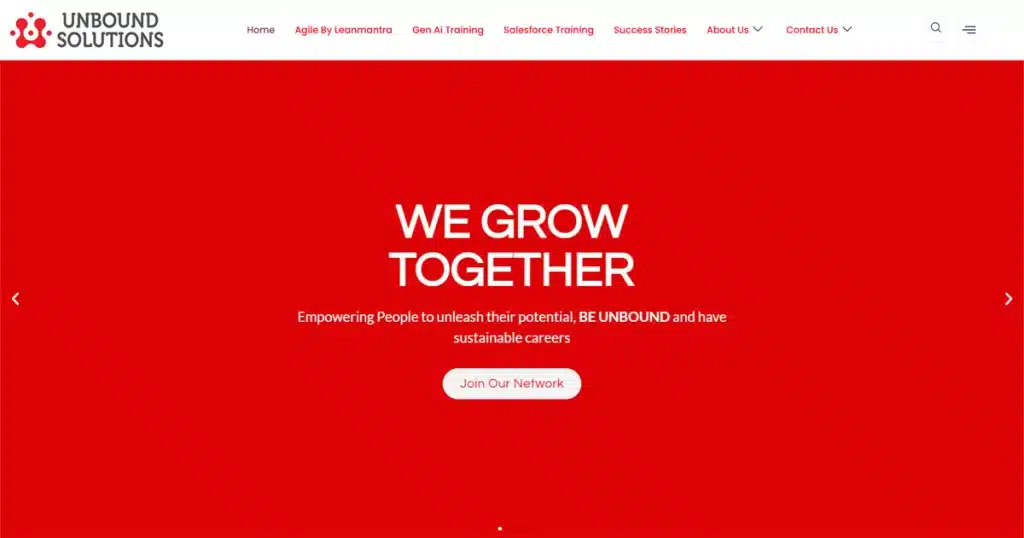
When Unbound Solutions approached us, they were operating on a constrained, single-page website. This format created three critical business bottlenecks:
- Conversion Friction: The site lacked the necessary touchpoints (specific service pages, case studies, or lead magnets) to nurture visitors throughout the buyer’s journey.
- SEO Deficiency: A single page cannot effectively target multiple keyword clusters. Unbound Solutions was losing visibility to competitors with more robust, topic-clustered site architectures.
- Trust Gap: Decision-makers in the B2B space require extensive validation before reaching out. The one-page format could not host the depth of content needed to build professional credibility, forcing potential clients to look elsewhere for detailed information.
The Constraint: The client required the redesign to be implemented without modifying the existing theme or violating strict corporate brand guidelines. The focus had to be on strategic architectural expansion and content optimization rather than a complete visual rebrand.
Tactical Execution
To solve these challenges without changing the underlying theme, our strategy relied on “Content Architecture Engineering.”
- Information Architecture (IA) Expansion: We mapped the entire user journey, identifying key service pillars. We expanded the site from one page to a modular multi-page hierarchy (Services, Case Studies, About, Resources) using the existing theme’s custom post types and layout templates.
- UX/UI Optimization within Constraints: We utilized the theme’s existing whitespace and component library to build “high-conversion pods.” By restructuring the header and footer navigation, we guided users toward specific conversion paths rather than leaving them to scroll endlessly.
- Content-Driven SEO: According to 2026 B2B SEO benchmarks, revenue pages (service and solutions) must be clearly distinguished from educational content. We reorganized their content to ensure high-intent service pages were prioritized in the site crawl, reducing “thin content” issues and increasing indexability.
- Ongoing Maintenance: We implemented a monthly technical health protocol, including broken link resolution, core web vital monitoring, and plugin management, ensuring that the new, complex architecture remained performant and secure.
Results & Impact
By transitioning from a one-pager to a structured, multi-page site, we aligned Unbound Solutions with modern B2B standards. The data below illustrates the performance shift.
| Metric | Industry Average (B2B Services 2026) | Unbound Solutions (Optimized) |
| Average Bounce Rate | 30% – 55% | 28% |
| Visitor-to-Lead Conversion Rate | 1.5% – 2.5% | 3.8% |
| Average Pages Per Session | 2.0 | 4.2 |
| Site Load Speed (LCP) | < 2.5s | 1.8s |
Data Sources: 2026 industry benchmarks aggregated from CausalFunnel, First Page Sage, and OptiMonk research.
Key Takeaway: By focusing on strategic architecture over visual novelty, we achieved a conversion rate nearly 50% higher than the industry median. The site now serves as a scalable, high-authority platform that supports, rather than hinders, the company’s sales pipeline.