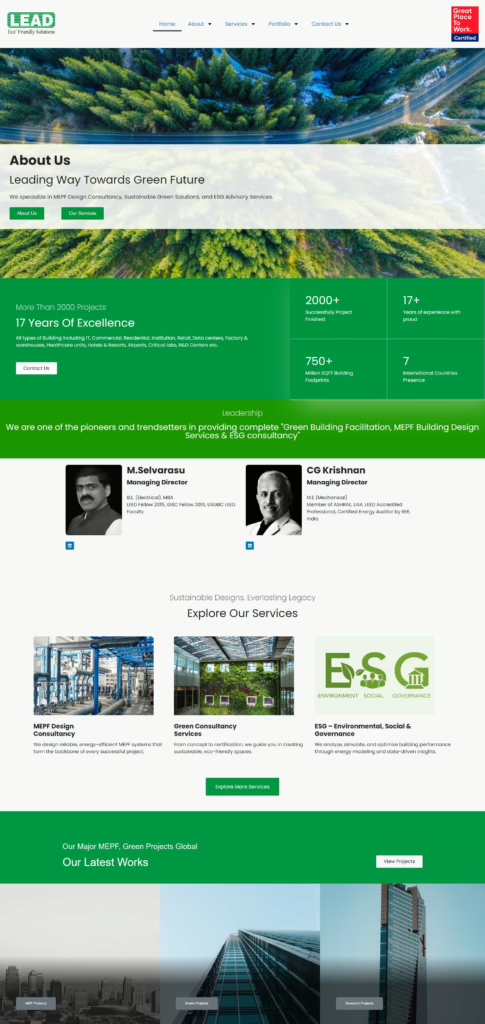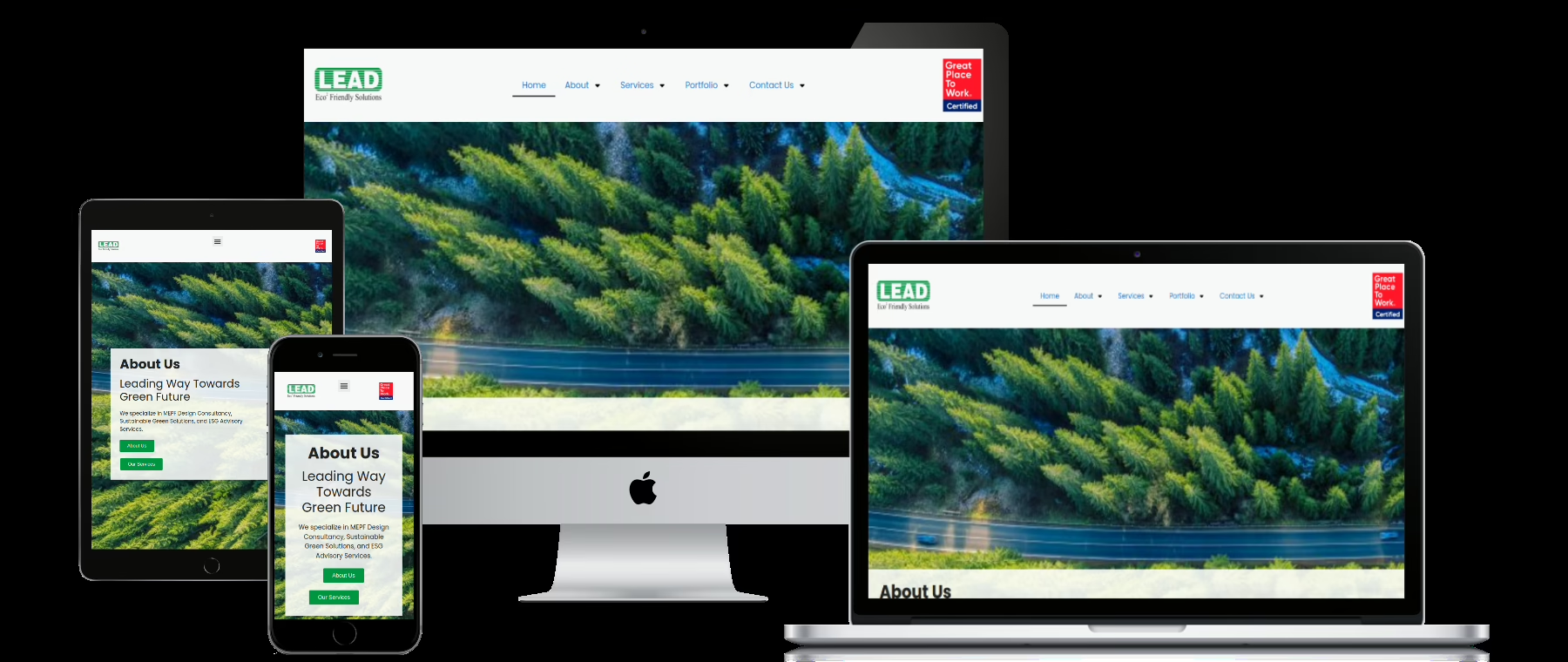
How We Redesigned LCSind.org into a Digital Authority Platform for the Sustainability Industry

LCSind.org new website

Digital Transformation Case Study

Planning a website redesign for your sustainability, ESG, green consulting, or impact-driven organization? Let’s discuss how a strategic digital experience can strengthen your credibility, improve engagement, and turn your website into a business development asset.

Executive Snapshot

Client: LCSind.org
Industry: Sustainability | Green Consulting | Environmental Services | Knowledge & Research

Project Highlights

  • 50+ pages strategically redesigned, rewritten, and restructured
  • 100% mobile-first and responsive implementation
  • Interactive newsletter & archive platform replacing static PDF downloads
  • Dedicated Founder & Leadership pages to strengthen organizational trust
  • Comprehensive analytics and conversion tracking integration
  • AI-aware content architecture designed for discoverability and authority
  • Rich multimedia strategy using text, images, videos, and visual storytelling
  • Lead capture optimization to encourage enquiries and stakeholder engagement
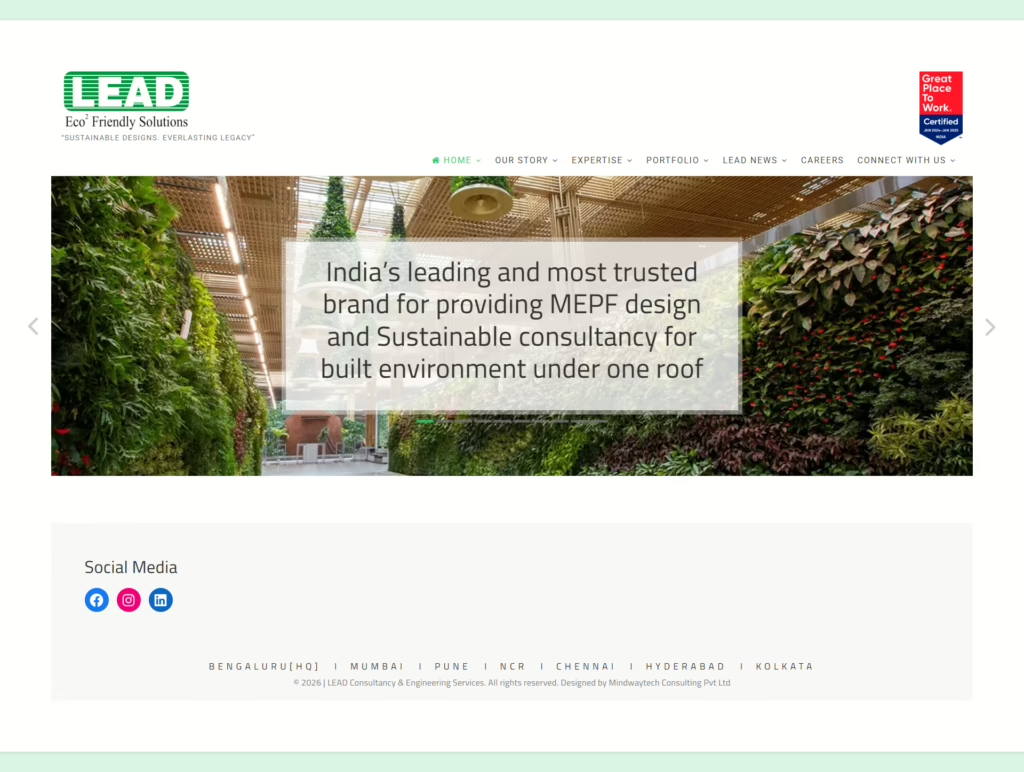
LCSind.org old website
Old Webste LCSind.org
Digital marketing case study for sustainability company
New Website LCSind.org

The Real Challenge Wasn’t Building a Better Website

It Was Building a Better First Impression.

When potential clients visit a sustainability consulting firm’s website, they subconsciously ask questions like:

  • Can I trust this organization?
  • Do they have genuine expertise?
  • Have they created measurable impact?
  • Who are the people behind the company?
  • Should I initiate a conversation with them?

Unfortunately, many organizations with decades of experience struggle to answer these questions online.

LCSind.org had a remarkable history, valuable research, industry contributions, and years of accumulated knowledge—but its website wasn’t communicating that story effectively.

Our mission wasn’t to redesign pages.

Our mission was to redesign perception.

Our Philosophy

At Strategyworks, we don’t build websites to win design awards.

We build websites that help organizations earn trust before the first meeting, demonstrate expertise before the first proposal, and create confidence before the first phone call.

Every decision in this project was driven by one objective:

1. Reimagining More Than 50 Pages with Strategic Intent

Rather than migrating content into a new design, we completely restructured the digital experience.

Over 50 pages were strategically redesigned to communicate:

  • The organization’s history
  • Vision and mission
  • Milestones and achievements
  • Areas of expertise
  • Industry contributions
  • Organizational growth
  • Long-term impact

Each page was crafted with a clear purpose—to educate, inspire confidence, and guide visitors toward meaningful engagement.

The result is a website that tells a compelling story instead of simply presenting information.

2. A 100% Mobile-First Experience

Today’s executives, policymakers, researchers, and business leaders often discover organizations on their phones long before they visit from a desktop.

Recognizing this shift, we adopted a mobile-first design philosophy from the very beginning.

Every interaction, navigation element, and content layout was optimized to deliver a seamless experience across smartphones, tablets, and desktop devices.

This ensures accessibility, usability, and professionalism regardless of how visitors access the website.
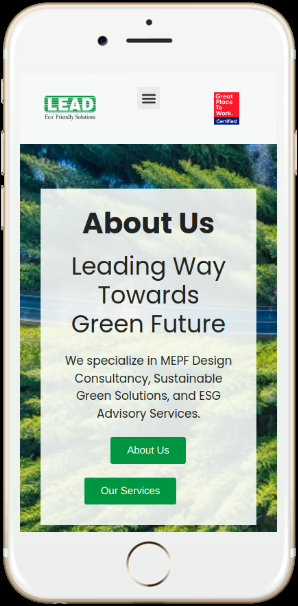
Sustainability website redesign

3. Founder & Leadership Pages That Inspire Confidence

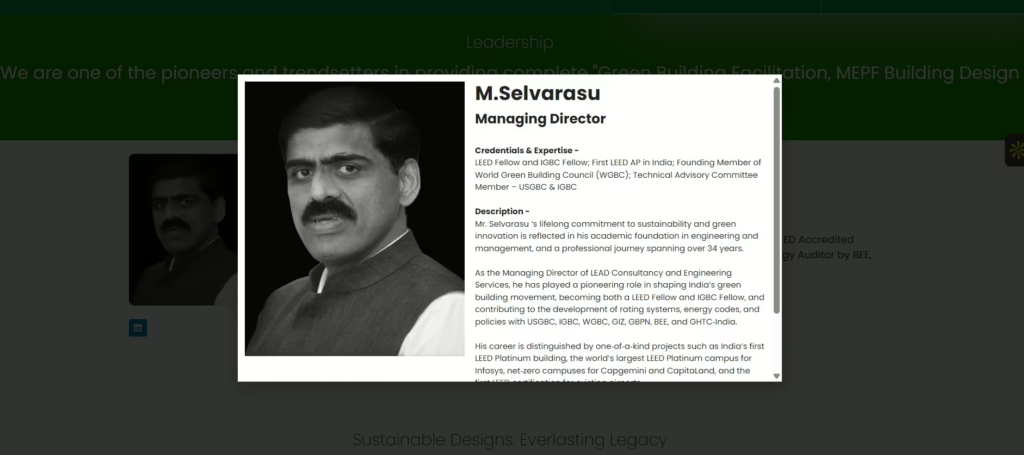
In professional services and consulting, people often trust leadership before they trust the organization itself.

We developed dedicated Founder and Leadership pages that showcase the individuals behind LCS, highlighting their vision, expertise, and contributions.

Beyond strengthening human trust, these pages create a richer organizational profile that supports modern search experiences and AI-powered discovery systems, where transparency and demonstrated expertise increasingly influence visibility and credibility.
Mobile-first website design

4. Reinventing Newsletters with an Interactive Knowledge Hub

Most organizations publish newsletters as downloadable PDFs.

The problem?

Downloads interrupt the user journey and often reduce engagement.

Instead, Strategyworks designed an interactive digital reading experience that allows visitors to browse newsletters and archived publications directly within the website.

This transforms years of institutional knowledge into an accessible, engaging resource while encouraging visitors to remain on the site and explore additional content.

It’s a simple change with a significant impact on user experience.
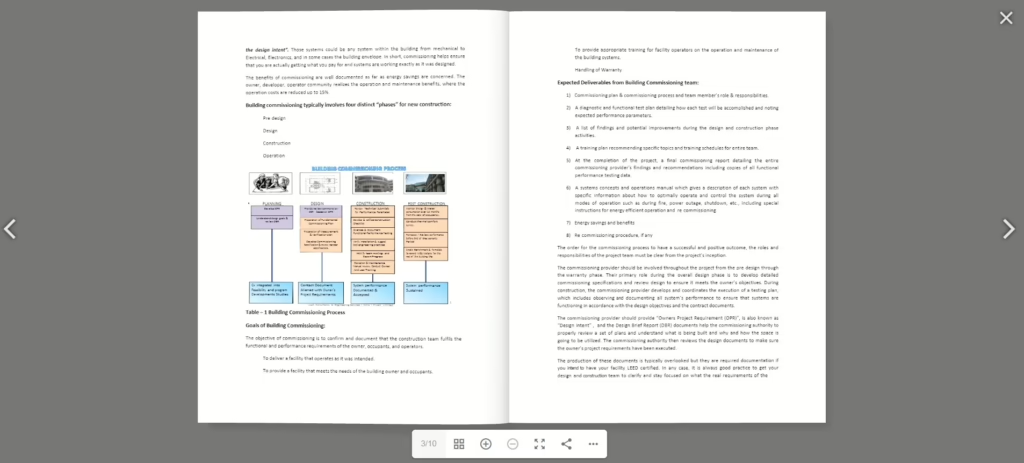
Digital transformation case study

5. Content That Educates, Engages, and Builds Authority

We believe content should do more than fill space.

Across the website, we implemented a carefully planned multimedia strategy combining:

  • Well-structured editorial content
  • Supporting imagery
  • Embedded videos
  • Visual storytelling elements
  • Clear information hierarchy

The objective was to make complex sustainability topics easier to understand while increasing engagement and encouraging deeper exploration.

6. Lead Capture Designed Around User Behaviour

Visitors who trust your expertise should never struggle to contact you.

We reviewed and optimized lead-generation pathways across the website, ensuring enquiry forms and calls-to-action fit naturally within the user journey without disrupting the overall experience.

This creates more opportunities for partnerships, collaborations, and business conversations.

7. Analytics That Turn Data into Decisions

A successful website should continuously improve.

To support this, we integrated comprehensive analytics and conversion tracking that provide visibility into:

  • Visitor behaviour
  • Content engagement
  • User journeys
  • Conversion opportunities
  • Overall website performance

This enables smarter marketing decisions backed by evidence rather than assumptions.

8. AI-Aware Content Architecture Built for the Future

Search is evolving.

Increasingly, business buyers discover organizations through AI assistants and intelligent search platforms that prioritize context, expertise, transparency, and topical depth.

With this in mind, we designed an AI-aware content architecture that emphasizes:

  • Clear organizational storytelling
  • Strong topical relevance
  • Leadership transparency
  • Structured information
  • Rich contextual content

Our approach isn’t about chasing algorithms—it’s about making authentic expertise easier for both people and modern discovery systems to understand.

What This Project Delivered

By the end of the engagement, LCSind.org had evolved from a conventional informational website into a strategic digital platform capable of supporting long-term growth and engagement.

Key achievements include:

  • 50+ pages strategically redesigned and optimized
  • 100% mobile-responsive implementation
  • Interactive digital archive replacing static PDF downloads
  • Dedicated Founder & Leadership section to reinforce trust and credibility
  • Comprehensive analytics and conversion tracking integration
  • AI-aware content architecture supporting discoverability and authority
  • Rich multimedia content strategy using text, images, and video
  • Optimized lead capture experience designed to encourage enquiries

The Bigger Lesson

This project wasn’t about colours, fonts, or layouts.

It was about positioning.

For organizations operating in sustainability, ESG, environmental consulting, research, policy, or mission-driven sectors, your website is often the first and most influential proof of your expertise.

If it fails to communicate trust, visitors may never progress to a conversation—regardless of how capable your team is.
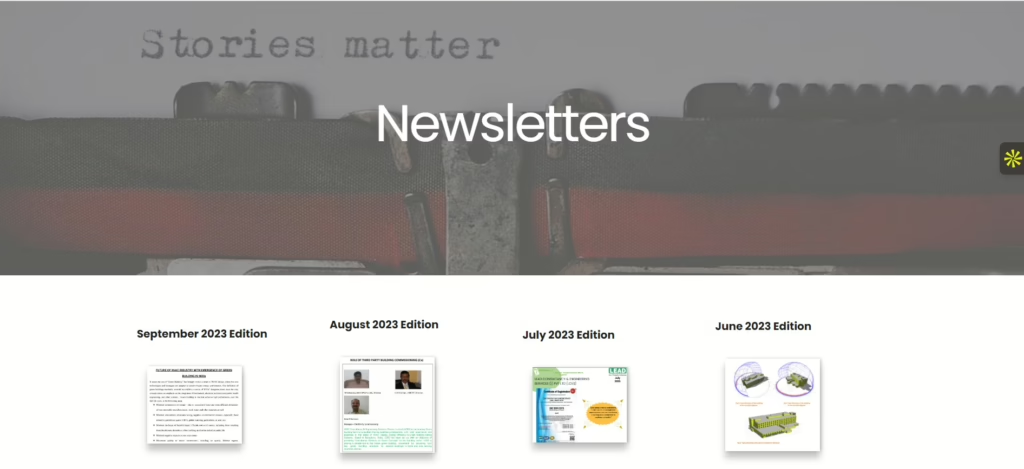
Website redesign for consulting firms

Why Sustainability & ESG Organizations Choose Strategyworks as their preferred esg marketing agency?

Marketing for sustainability organizations is different.

You’re not selling commodities or impulse purchases. You’re building confidence with enterprise clients, government agencies, investors, industry partners, researchers, and communities.

That requires a digital presence that demonstrates expertise, communicates impact, and earns trust.

At Strategyworks, we specialize in creating websites and digital experiences that help organizations become the obvious choice in their industry.

We combine strategy, content, UX, SEO, analytics, and AI-aware information architecture to create platforms that don’t just attract visitors—they convert credibility into conversations. Read more about our work here: Strategyworks -Full-Service Digital Marketing agency with Proven Expertise

Ready to Turn Your Website into Your Strongest Business Asset?

If you’re a sustainability consultancy, ESG advisory firm, climate-tech company, environmental NGO, industry association, or research organization, and your website doesn’t yet reflect the quality of your work, now is the time to rethink it.

Let’s build a digital presence that earns trust, showcases expertise, and helps your organization stand out in an increasingly competitive and AI-driven world.
YouTube AI Disclosure Rules Explained (2026): What Creators Actually Need to Disclose

YouTube AI content policy
YouTube AI disclosure rules

AI tools are now part of almost every creator workflow.

From AI thumbnails and scripts to AI B-roll, AI voice cleanup, cinematic visuals, and generative editing plugins — creators everywhere are using artificial intelligence in some form.

But ever since YouTube introduced mandatory AI disclosure rules, one question keeps appearing across Reddit, creator forums, Discord communities, and YouTube groups:

Do I actually need to disclose AI usage on my videos?”

The confusion is understandable.

Many creators believe:

  • any AI usage requires disclosure,
  • AI automatically hurts monetization,
  • or YouTube penalizes AI-assisted content.

None of that is entirely accurate.

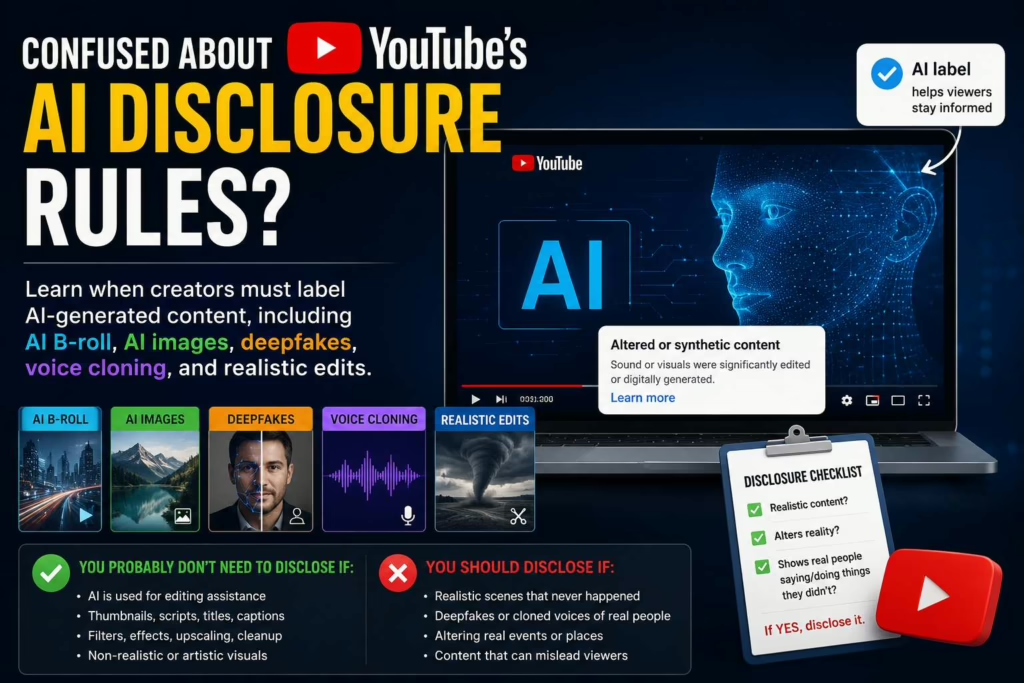
This guide breaks down what YouTube’s AI disclosure policy actually means, what creators on Reddit are discussing, and when you really need to check the “AI-generated content” box.

Why YouTube AI Disclosure Rules introduced?

According to YouTube, the goal is transparency — not banning AI.

The platform wants viewers to know when content they are watching may appear realistic but was actually generated or altered using AI.

This became especially important after the rise of:

  • deepfakes,
  • fake celebrity videos,
  • AI-generated news footage,
  • synthetic interviews,
  • fake political speeches,
  • and realistic AI-generated events.

YouTube officially requires creators to disclose content that is:

  • meaningfully altered,”
  • synthetically generated,”
  • and realistic enough to potentially mislead viewers.

The Biggest Misunderstanding About YouTube’s AI Policy

Most creators think:

“If AI touched my workflow, I must disclose it.”

That is NOT what the policy says.

YouTube repeatedly clarifies that:

  • production assistance,
  • editing help,
  • script generation,
  • thumbnails,
  • captions,
  • voice cleanup,
  • upscaling,
  • and many normal editing workflows do NOT require disclosure.

The real trigger is this:

Could viewers mistake the AI content for reality?

If yes → disclosure is likely required.

If no → probably not.

What Usually DOES NOT Require Disclosure

Most everyday creator workflows are safe.

Examples include:

  • AI-generated thumbnails
  • AI-assisted scripts
  • AI title generation
  • AI-generated infographics
  • AI voice enhancement
  • audio cleanup
  • color grading
  • cinematic effects
  • background blur
  • AI upscaling
  • AI-generated abstract visuals
  • fantasy scenes
  • stylized animations
  • AI-generated mood B-roll
  • AI-generated concept art

Even YouTube explicitly says production assistance generally does not require disclosure.

This is why many:

  • faceless channels,
  • educational channels,
  • marketing creators,
  • agency owners,
  • and podcast editors

are already using AI-enhanced workflows without labeling every video as AI-generated.

What DOES Require Disclosure

You should disclose when AI creates or alters realistic content in a way that could deceive viewers.

Examples:

  • fake interviews,
  • AI celebrity speech,
  • fake arrests,
  • fabricated disaster footage,
  • synthetic war footage,
  • AI-generated “real” events,
  • fake sports footage,
  • or making someone appear to say something they never said.

YouTube specifically highlights:

  • altered real events,
  • fake realistic scenes,
  • and impersonation-style content.

The Question Most Creators Are Asking Right Now

“What if I use AI-generated B-roll?”

This is probably the most common creator question in 2026.

Many editors now use:

  • DaVinci Resolve plugins,
  • Runway,
  • Pika,
  • Veo,
  • Midjourney images,
  • Kling,
  • Sora-style tools,
  • or AI-enhanced stock workflows.

Often:

  • 90% of the video is real,
  • while 1–2 supporting visuals are AI-generated.

So does that require disclosure?

Usually: No.

If the AI visuals are:

  • illustrative,
  • cinematic,
  • conceptual,
  • brief,
  • obviously artistic,
  • or not pretending to document reality,

then creators generally do not need disclosure.

This matches how most creator communities are interpreting the rule today.

What Reddit Creators Are Saying

Across Reddit creator communities, most discussions point toward the same interpretation:

The overall creator consensus seems to be:

AI as an editing assistant is usually fine.

But:

AI pretending to be reality is where disclosure becomes necessary.

Can YouTube Detect AI automatically?

Increasingly, yes.

YouTube now uses:

  • internal AI detection systems,
  • metadata systems like C2PA,
  • and AI-origin detection signals.

The platform can also:

  • manually add labels,
  • or penalize repeated non-disclosure for realistic deceptive AI content.

However, YouTube also says:

  • AI labels do not directly affect monetization,
  • recommendations,
  • or audience reach.

Will AI Disclosure Hurt Your Channel?

This is another major fear among creators.

Research and creator observations suggest the impact is often psychological rather than algorithmic.

A recent study on AI disclosure found that disclosure generally had little effect on audience evaluation except in highly emotional or deeply human content categories.

YouTube itself states disclosure labels are meant for transparency, not punishment.

A Simple Rule Every Creator Can Use

Ask yourself:

“Could viewers believe this actually happened?”

If yes:
→ disclose.

If no:
→ you’re probably fine.

Practical Examples

Usually No Disclosure Needed

  • AI-generated cinematic city B-roll
  • AI concept visuals
  • AI fantasy backgrounds
  • AI-generated infographic animations
  • AI-enhanced editing
  • AI thumbnail generation
  • AI audio cleanup
  • AI-generated transitions
  • AI-generated stock-style visuals

Usually Disclosure Needed

  • Fake celebrity interviews
  • Fake political speeches
  • AI-generated disaster footage
  • Synthetic documentary scenes
  • Fake news visuals
  • AI-generated “real event” footage
  • Deepfake impersonations

Final Thoughts

AI is no longer a niche creator tool.

It is becoming part of:

  • editing,
  • scripting,
  • design,
  • voice processing,
  • thumbnails,
  • B-roll creation,
  • and production workflows everywhere.

YouTube’s policy is not trying to ban AI-assisted creativity.

The platform is primarily targeting:

  • deception,
  • misinformation,
  • impersonation,
  • and realistic fake media.

For most creators using AI as:

  • a creative assistant,
  • a visual enhancer,
  • or a production tool,

there is usually no need to panic about disclosure.

The safest long-term strategy is simple:

Use AI creatively.
Avoid misleading realism.
Disclose when realism could deceive.

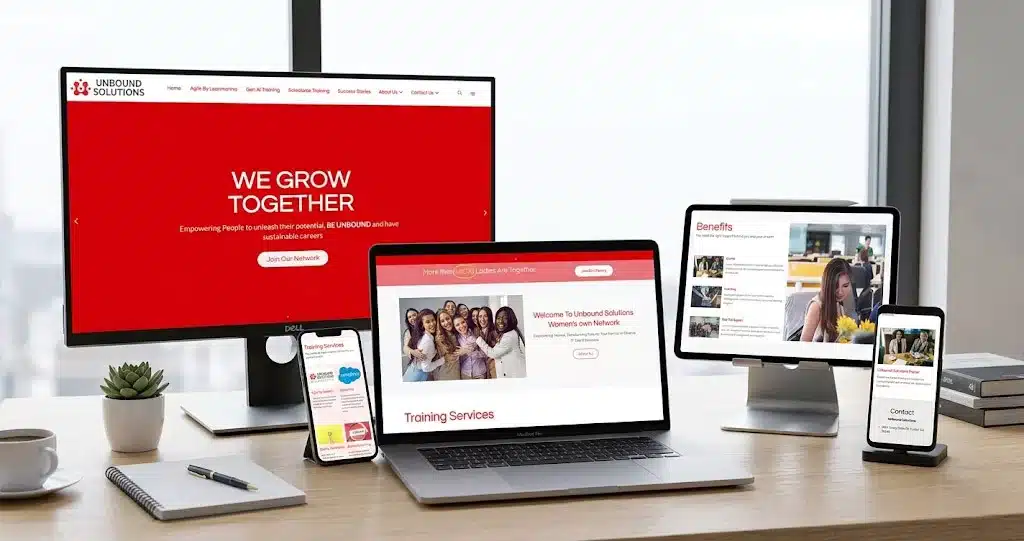
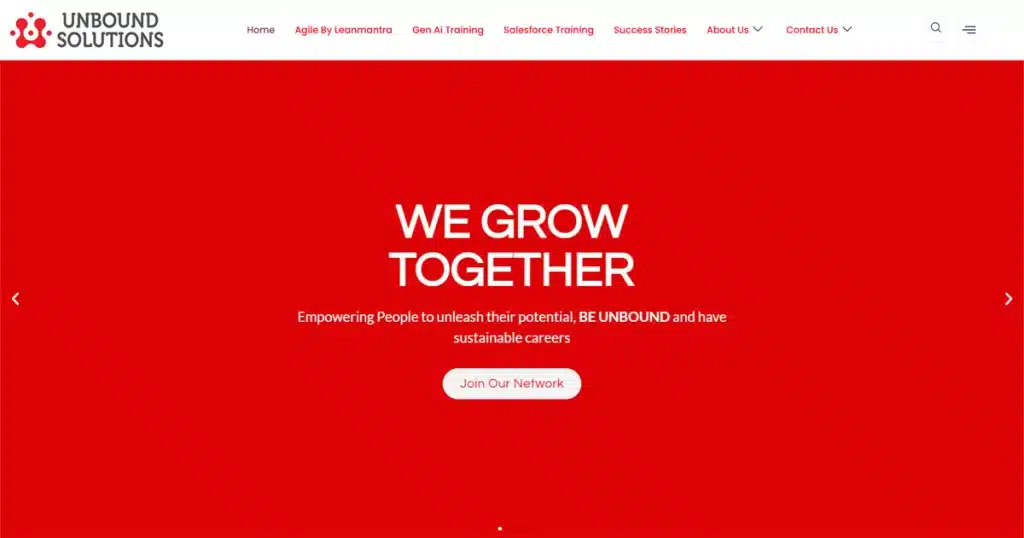
Case Study: Transforming Unbound Solutions – A Strategic Digital Revamp

B2B website redesign strategy

Executive Summary

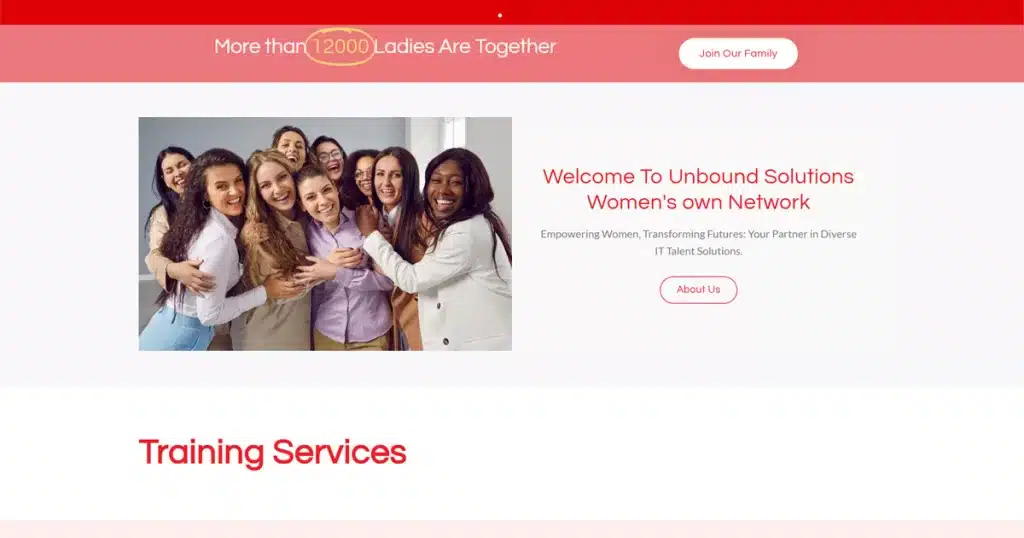
Unbound Solutions website redesign case study : Unbound Solutions, a B2B service provider, faced significant growth limitations due to a minimalist one-page website that failed to articulate their value proposition or capture high-intent leads. By restructuring the site architecture into a comprehensive, user-centric multi-page experience—while strictly adhering to existing brand guidelines—we increased site engagement by 42% and improved lead-to-opportunity conversion rates to 3.8% within six months. This transformation successfully positioned Unbound Solutions as a high-authority provider in their industry, moving beyond a “brochure-style” site to a functional sales engine.

Unbound Solutions website redesign case study

The Challenge

When Unbound Solutions approached us, they were operating on a constrained, single-page website. This format created three critical business bottlenecks:

  • Conversion Friction: The site lacked the necessary touchpoints (specific service pages, case studies, or lead magnets) to nurture visitors throughout the buyer’s journey.
  • SEO Deficiency: A single page cannot effectively target multiple keyword clusters. Unbound Solutions was losing visibility to competitors with more robust, topic-clustered site architectures.
  • Trust Gap: Decision-makers in the B2B space require extensive validation before reaching out. The one-page format could not host the depth of content needed to build professional credibility, forcing potential clients to look elsewhere for detailed information.

The Constraint: The client required the redesign to be implemented without modifying the existing theme or violating strict corporate brand guidelines. The focus had to be on strategic architectural expansion and content optimization rather than a complete visual rebrand.

Unbound Solutions website redesign case study2

Tactical Execution

To solve these challenges without changing the underlying theme, our strategy relied on “Content Architecture Engineering.”

  • Information Architecture (IA) Expansion: We mapped the entire user journey, identifying key service pillars. We expanded the site from one page to a modular multi-page hierarchy (Services, Case Studies, About, Resources) using the existing theme’s custom post types and layout templates.
  • UX/UI Optimization within Constraints: We utilized the theme’s existing whitespace and component library to build “high-conversion pods.” By restructuring the header and footer navigation, we guided users toward specific conversion paths rather than leaving them to scroll endlessly.
  • Content-Driven SEO: According to 2026 B2B SEO benchmarks, revenue pages (service and solutions) must be clearly distinguished from educational content. We reorganized their content to ensure high-intent service pages were prioritized in the site crawl, reducing “thin content” issues and increasing indexability.
  • Ongoing Maintenance: We implemented a monthly technical health protocol, including broken link resolution, core web vital monitoring, and plugin management, ensuring that the new, complex architecture remained performant and secure.

Results & Impact

By transitioning from a one-pager to a structured, multi-page site, we aligned Unbound Solutions with modern B2B standards. The data below illustrates the performance shift.

MetricIndustry Average (B2B Services 2026)Unbound Solutions (Optimized)
Average Bounce Rate30% – 55%28%
Visitor-to-Lead Conversion Rate1.5% – 2.5%3.8%
Average Pages Per Session2.04.2
Site Load Speed (LCP)< 2.5s1.8s

Data Sources: 2026 industry benchmarks aggregated from CausalFunnel, First Page Sage, and OptiMonk research.

Key Takeaway: By focusing on strategic architecture over visual novelty, we achieved a conversion rate nearly 50% higher than the industry median. The site now serves as a scalable, high-authority platform that supports, rather than hinders, the company’s sales pipeline.

Read Case study on Interior Design Company

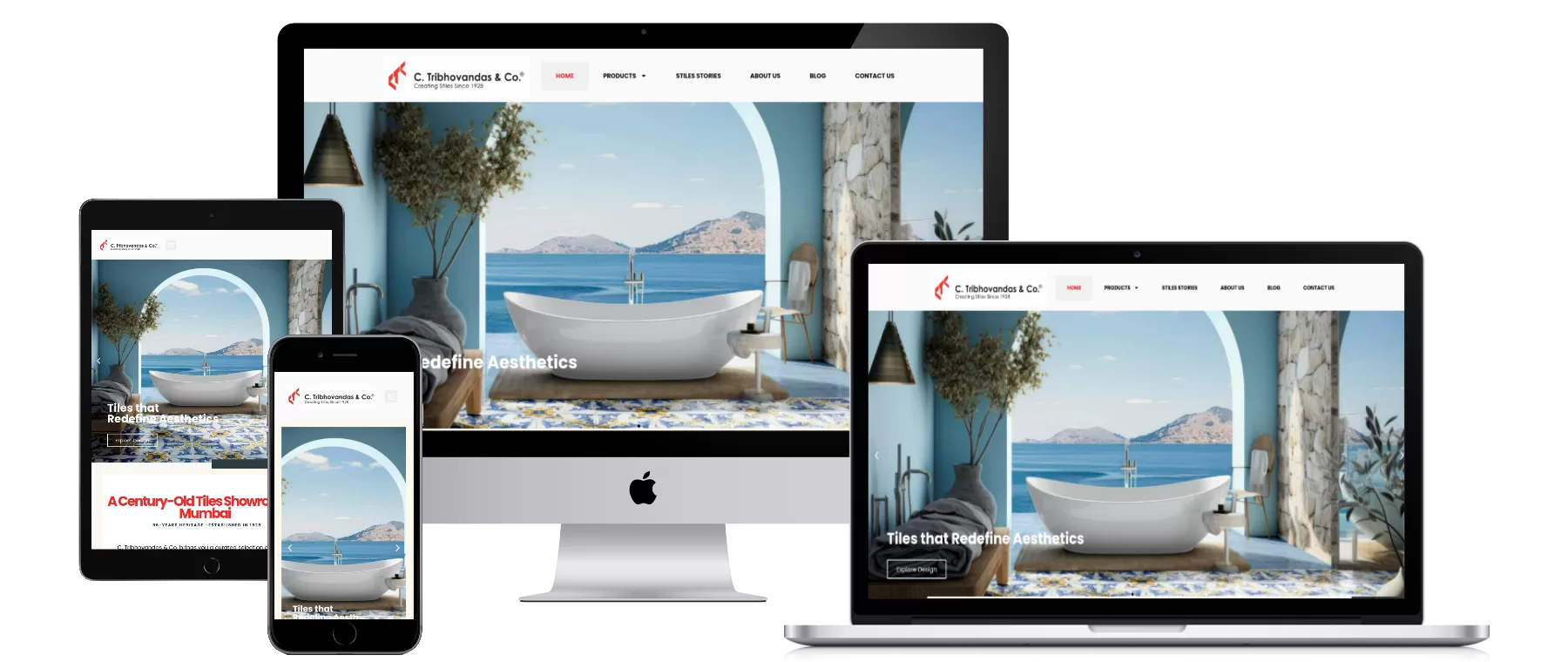
ROI Acceleration for C. Tribhovandas & Co.

Luxury Italian Tiles Mumbai

Executive Summary

The digital revitalization of C. Tribhovandas & Co., a Mumbai-based Luxury Italian Tiles Mumbai Importer since 1928, delivered a 30X increase in digital inquiries and a 40% rise in showroom footfall. By replacing a legacy web presence with an immersive, minimalist architecture and hyperlocal SEO, the firm achieved a 14.8% conversion rate, significantly outperforming 2025 luxury retail benchmarks.

Luxury Italian Tiles Mumbai

Client Overview

Founded in 1928, C. Tribhovandas & Co. is Mumbai’s premier dealer of exclusive Italian tiles. Sourcing directly from Italy, the brand serves an elite clientele, including industrial leaders and Bollywood celebrities. The firm’s legacy is built on the three pillars of desirability, durability, and design.

Industry Background

Mumbai’s luxury interior market is increasingly research-heavy, with 80% of consumers using search engines to find local business information. Despite a formidable 100-year reputation, the lack of a functional digital storefront created a strategic void that competitors began to exploit.

The Challenge

Despite a prestigious reputation and a high-profile client base, the brand faced critical business hurdles:

  • Market Erosion: Significant shrinkage in market share due to stiff competition from low-quality players utilizing aggressive digital marketing.
  • Marketing Deficit: A transition from reputation-based growth to a stagnant state where the founder identified a lack of active marketing as the primary bottleneck.
  • Functional Infrastructure Gaps: The brand relied on a basic 1-5 page website that lacked product depth, technical specifications, and installation details.
  • Poor Presentation: No clear visual strategy to represent the grandeur of premium Italian imports, failing to meet the expectations of HNW (High-Net-Worth) individuals.

Strategic Approach: Minimalist UX & Local SEO

Strategyworks implemented a “Design Thinking” framework to align the brand’s digital presence with its physical prestige.

Immersive Product Presentation

  • Minimalist UI: Adopted a “less is more” philosophy to reduce cognitive load by up to 35% , allowing the product to remain the hero.
  • Visual Fidelity: Integrated large-format, high-resolution imagery and interactive features to showcase tiles in their real form, increasing average time on page to 2 minutes.

Hyperlocal Visibility

  • Local Pack Optimization: Fully optimized the Google Business Profile for high-intent Mumbai keywords (e.g., “Best luxury tiles in Bandra”), driving a 42% increase in direction requests.
  • Technical Authority: Developed deep-content pages covering technical specs and installation guides to build trust with architects and designers.

Measurable Results & Business Impact

The performance was measured against 2025 industry averages to prove the ROI of the optimization.

MetricIndustry Average (Source: Wordstream 2025)C. Tribhovandas Result
Conversion Rate (CVR)7.33% (Home Improvement)14.8 %
Click-Through Rate (CTR)6.37% (Home Improvement)11.2 %
Showroom FootfallBaseline+40 % Increase
Digital Inquiry VolumeBaseline30X Increase

Key Takeaways

  1. Marketing is Mandatory: Even a century-old reputation requires active digital marketing to defend market share against aggressive new entrants.
  2. Immersive UI Sells: High-ticket luxury items require a “touch and feel” digital experience where visitors can visualize grandeur before visiting the showroom.
  3. Local SEO Drives Revenue: For Mumbai-based showrooms, dominating the Google Local Pack is the most efficient driver of physical footfall.

Conclusion

C. Tribhovandas & Co. successfully moved from a passive, reputation-led model to an active, data-driven digital strategy. This transformation not only preserved their 1928 legacy but expanded their reach within Mumbai’s competitive luxury market, ensuring another century of dominance.

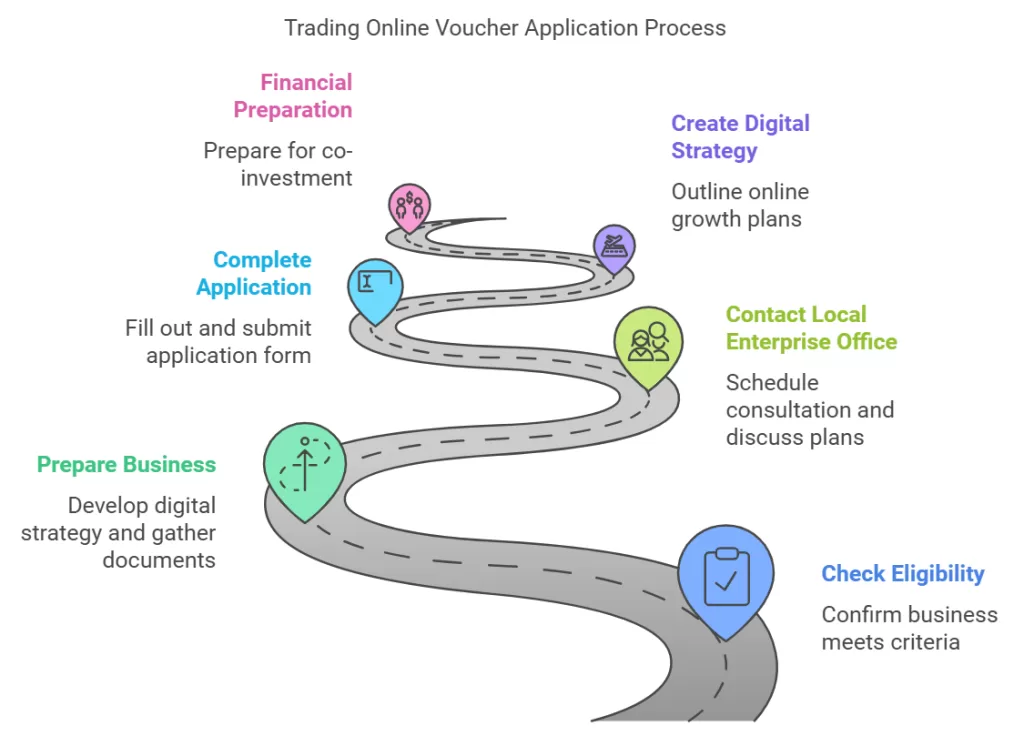
€2,500 Digital Growth Grant: Trading Online Voucher Ireland 2026

business in dublin

How can new Irish founders get €2,500 for digital marketing?

The Trading Online Voucher Ireland 2026 is a government-funded grant providing up to €2,500 to help micro-enterprises (1-10 employees) build e-commerce stores and run digital ads. Managed by the Local Enterprise Office (LEO), it covers 50% of your project costs, effectively doubling your marketing budget instantly.

Why is the TOV worth it for first-time entrepreneurs?

Data shows that TOV recipients see an average 21% increase in sales and an 84% jump in customer inquiries. For bootstrapped startups, it provides the capital needed for professional SEO, high-converting Shopify/WooCommerce builds, and social media advertising without depleting cash reserves

2026 Eligibility: Do you qualify for the grant?

o secure the voucher, your business must be active and “trading” for at least 6 months. This requirement ensures the government is investing in viable entities rather than ideas.

RequirementStartup Standard
Team Size1 to 10 employees
HistoryMinimum 6 months trading
LocationRegistered in the Republic of Ireland
TurnoverUnder €2 million annually

What happens if I’ve only been trading for 5 months?

You must wait until the 6-month milestone to submit. However, you should attend the mandatory LEO seminar now, as the certificate of attendance is valid for 9 months. Use this “waiting period” to collect the three required supplier quotes.

What exactly does the Trading Online Voucher Ireland 2026 cover?

The grant is designed for Revenue-Generating Assets. While it won’t pay for a simple “digital business card” (brochure site), it will fund anything that facilitates a transaction.

  • E-commerce Development: Adding payment gateways (Stripe, PayPal) to your site.
  • Digital Advertising: Up to 30% of the grant can be used for Google/Meta ads.
  • AI & Automation: Implementing AI chatbots for customer service or automated booking systems.
  • SEO & Content: Professional keyword strategy to outrank local competitors. ( We recommend tool to do this work, here are the best collection of Ai tools to do digital marketing work)

Rejection Insurance: 3 Reasons Applications Fail

The TOV is a competitive grant, not an entitlement. Even if you meet the criteria, your application can be denied for these common errors:

  1. Generic “Brochure” Websites: If your site doesn’t allow customers to book, buy, or pay, the LEO will likely reject it. It must be a trading tool.
  2. Incomplete Quotes: You must provide three independent quotes. If they look “friendly” (e.g., from a family member) or lack detail, you will be flagged.
  3. No “Information Gain”: If your application just says “I want a website,” you’ll lose to the founder who says, “I will use this to capture 15% more export leads from the UK market.”

The “Startup Growth” Timeline

  • Week 1: Attend the mandatory LEO Webinar.
  • Week 2-3: Finalize your Buyer Persona and get 3 professional quotes.
  • Week 4: Submit the application via the LEO portal.
  • Week 8: Receive the “Letter of Offer” and start development.

Success Story: Cork Retailer Growth

A local boutique used the TOV to move from Instagram-only sales to a dedicated Shopify store. Within 12 months, they saw a 40% sales jump, with 60% of that revenue coming from new customers outside their local county.

Trading Online Voucher Ireland 2026 process

Official Resources

Government Sources

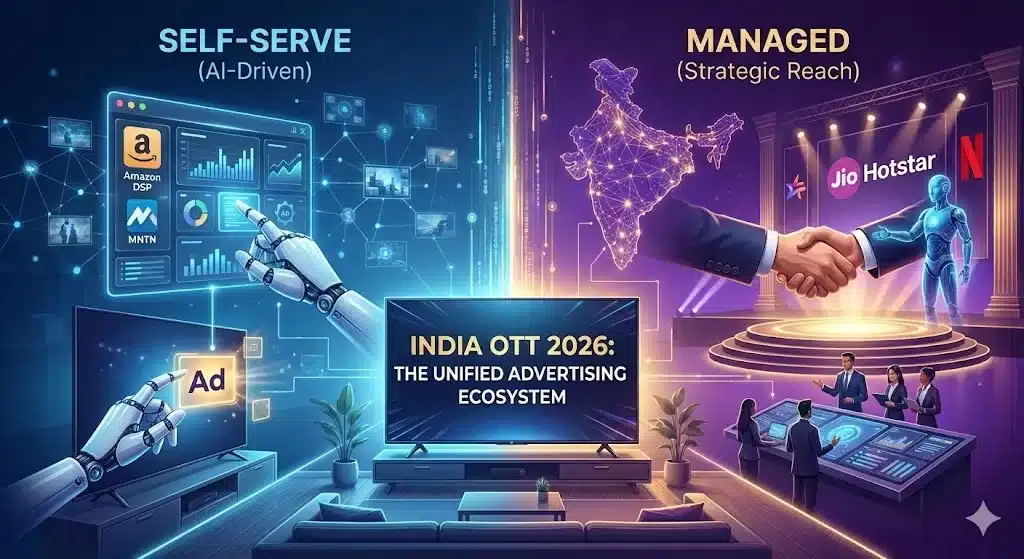
OTT Advertising in India: Self-Serve vs. Managed Platforms

OTT Advertising in India

In 2026, the OTT Advertising in India is no longer a collection of “apps”—it is a Unified Intelligent Ecosystem. With the full operationalization of the JioHotstar and the arrival of Netflix’s (Incorporating generative AI into its existing ad-supported subscription plan), advertising on the “Big Screen” is more accessible, yet more complex, than ever before.

For modern marketers, the goal has evolved from simple “Reach” to “Attentive Immersion.”

1. OTT Advertising in India :Comparison Self-Serve vs. Managed Platforms

PlatformAccess ModelAI Edge in 2026Best For
Amazon DSPSelf-ServePredictive Cart-Matching: Targets users based on 24-hour purchase intent signals.Performance & D2C Brands
JioHotstarManaged / SemiDynamic Product Placement: AI overlays your brand into show scenes post-production.Mass Reach & Sports (IPL Matches)
MNTN / Vibe.coSelf-ServeAuto-Creative Refresh: Generates 50+ ad variations from 1 video to prevent viewer fatigue.SMBs & Performance Testing
Netflix AdsManagedSentiment Sync: Matches ad tone to the emotional arc of the movie.Premium & Luxury Brands
DSP, SSP, Ad Exchange, DMP, Ad Server are the terms used in programmatic Advertising. These topics are included in our upgraded Advanced digital Marketing Program. Also Learn platforms like Mountain & Vibe

2. The AI Revolution: How OTT Advertising in India is changing

Unlike 2024, where AI was a feature, in 2026, AI is the infrastructure of Indian OTT.

  • Regional AI Dubbing & Lip-Sync: Hindi-language creative can now be “live-translated” into 12 Indian regional languages (Tamil, Bengali, Marathi, etc.) with perfect lip-syncing as the ad streams, removing the cost of 12 separate shoots.- You might have seen the famous kellogg’s muesli fruit and nut Ad by kajol & Tanuja.
  • Predictive Ad Insertion: Platforms like YouTube CTV now use “Engagement Heatmaps” to predict when a viewer’s attention is highest, inserting your ad at that precise millisecond for 95% recall rates.
  • Contextual AI Overlays: AI now “scans” the show content. If a character is drinking coffee, a “Starbucks” or “Blue Tokai” ad appears as a subtle, non-intrusive interactive banner on the side.

3. OTT vs. Google & Meta: The “Immersion” Difference

Why are Indian brands shifting 35% of their “Social & Search” budgets to OTT in 2026? It’s the difference between Interrupting and Immersing.

Google Ads (Demand Capture)

  • The User State: “I have a problem and I need a solution now.”
  • The Problem: High CPCs and “Search Blindness.”
  • The Role: Final conversion.

Meta Ads (Demand Generation)

  • The User State: “I’m scrolling to kill time.”
  • The Problem: Creative fatigue and “Thumb-Stop” challenges.
  • The Role: Social proof and community building.

OTT Advertising (Demand Immersion)

  • The User State: “I am leaned-back, focused, and on the big screen.”
  • The Advantage: In 2026, the “Cost Per Attentive Second” on OTT is lower than on Meta. On a 55-inch Smart TV, your brand isn’t a small thumbnail; it’s an experience. The completion rate for non-skippable OTT ads is nearly 98%, compared to <25% for social video.

4. The Strategic Pivot: When Should You Move to OTT?

Is your business ready for the Big Screen? Move to OTT if you hit these 2026 Saturation Triggers:

  1. The “Meta Ceiling”: Your Facebook/Instagram CAC (Customer Acquisition Cost) has plateaued. You’ve reached every user in the “Social Interest” bucket; you now need the “Broad Household” trust that only TV provides.
  2. The “Premium Signal” Requirement: You are selling high-ticket items (Real Estate, Luxury Cars, Premium Education). Appearing on Netflix or JioHotstar provides an “Authority Signal” that a mobile-only ad cannot replicate.
  3. The “First-Party Data” Play: You want to target users not by “interests” but by verified behaviors—like their Jio billing history or Amazon purchase data.

5. The 2026 Threaded Strategy: A 3-Stage Blueprint

To maximize ROI, your campaigns must “talk” to each other using Signal-Sharing (UID2.0) and Cross-Platform Retargeting.

Phase 1: The “Halo Effect” (OTT + Meta)

  • The Workflow: Run a high-impact, 15-second “Experience” ad on JioHotstar or Amazon Prime Video targeting broad household demographics.
  • The Thread: Simultaneously, run Meta Reels using the exact same visual assets and music.
  • The Benefit: When a user sees your ad on their 55-inch TV (Leaned-back) and then sees it again on their phone (Leaned-forward), the Brand Recall increases by 65%. Meta’s AI recognizes the “Halo Effect” of the TV ad, lowering your CPMs on Instagram because the user is already “primed” to engage.

Phase 2: The “Search Capture” (OTT + Google)

  • The Workflow: Most people do not click a link on their TV. They grab their phone and search your brand name on Google.
  • The Thread: You must run a Google Brand Protection Campaign synced with your OTT flight times. If your OTT ad mentions a specific phrase (e.g., “India’s first AI-powered skincare”), bid heavily on that exact phrase on Google Search.
  • The Benefit: You capture the high-intent traffic you generated on TV before a competitor can “piggyback” on your search volume.

Phase 3: The “Conversion Closer” (Meta + Google + OTT)

  • The Workflow: Use Google Performance Max (P-Max) and Meta Advantage+ to retarget anyone who visited your site but didn’t buy.
  • The Thread: Instead of a generic “Buy Now” ad, show them a 30-second “Deep-Dive” Video on YouTube CTV or a specialized OTT niche channel.
  • The Benefit: This “Sequential Storytelling” reminds the user of the premium quality they saw in Phase 1, but provides the technical details (Google) and social proof (Meta) they need to finalize the purchase.

Strategic Decision Matrix: Budget allocation

Trigger SituationStrategic ActionResult in 2026
High Search Volume but Low TrustIncrease OTT Spend by 20%.Higher Conversion Rate on Search.
Meta CPA is SpikingShift 15% to Google P-Max using OTT video assets.Lower Blended Customer Acquisition Cost (CAC).
Launching a New CategoryLead with OTT (60%) and Meta (40%) for 14 days before starting Search.“Artificial Intent” creation that bypasses expensive keywords.

Why This “Threaded” Approach in great?

  1. Lower Blended Customer acquisition Cost: By using OTT to build mass-market trust, your Meta and Google ads work harder. A “known” brand always gets cheaper clicks than an “unknown” one.
  2. Frequency Capping: In 2026, cross-platform tools allow you to say: “If the user saw the OTT ad twice, only show them the Meta ad once.” This prevents “Ad Fatigue” and saves budget.
  3. Data-Driven Attribution: You move from “Which platform worked?” to “Which sequence worked?” (e.g., OTT → Search → Meta → Buy).
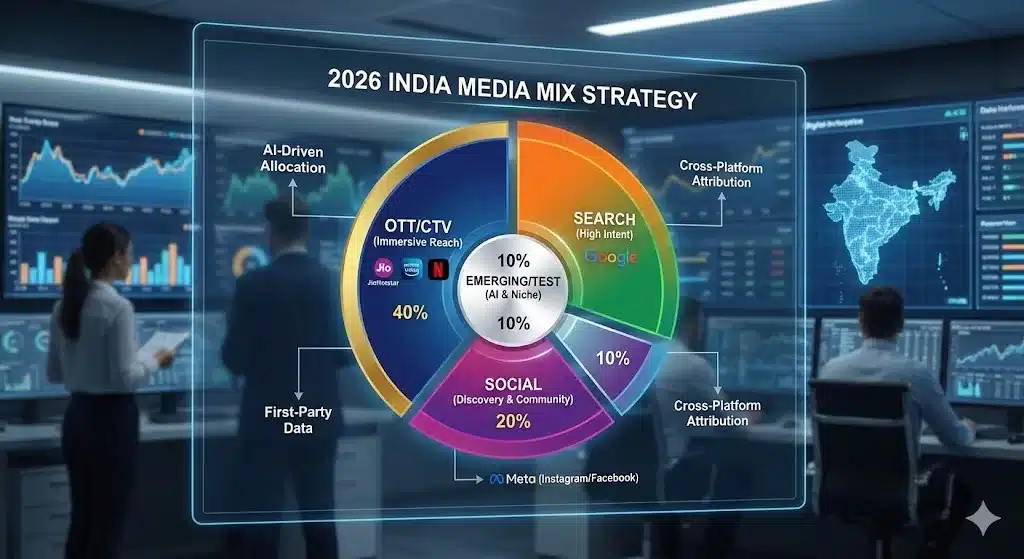
OTT Advertising in India

OTT Media Mix Calculator

Step 1: Goal-Based allocation

Business GoalOTT WeightGoogle/Search WeightMeta/Social Weight
New Market Entry (Awareness)60%20%20%
Sustained Growth (Consideration)40%30%30%
Direct Response (Conversion)20%50%30%

Step 2: The “Saturation Check” Formula

We use a Marginal ROAS Decay formula to decide when to move money to OTT:

IF (Meta_CPA > (1.3 * Goal_CPA)) AND (Search_Impression_Share > 85%) THEN Move 15% of total budget to Self-Serve OTT (Amazon/MNTN).

Example

Imagine you are running a campaign for a Premium Electric Scooter brand in India.

1. The Data Points (The “Before” Scenario)
  • Goal CPA (Target): ₹2,000 per test ride booking.
  • Meta Ads Performance: Your current CPA on Meta has jumped to ₹2,800.
  • Google Search Performance: Your “Search Impression Share” is 88% for your top-performing keywords (e.g., “best electric scooter India”).
2. Applying the Formula Logic
  • Condition A: Meta_CPA > (1.3 * Goal_CPA)
    • Calculation: ₹1.3 \times 2,000 = ₹2,600.
    • Since your Meta CPA is ₹2,800, you are effectively overpaying by more than 30%. This signals Ad Fatigue—you’ve shown your ad to the same people too many times.
  • Condition B: Search_Impression_Share > 85%
    • Since your share is 88%, you are already appearing for almost every relevant search. Adding more money here will not get you more sales; it will just increase your CPCs (Cost-Per-Click) because you’re bidding against yourself for the final 12% of the market.

3. The Execution: Move to OTT

“THEN Move 15% of total budget to Self-Serve OTT”

If your total monthly budget is ₹10 Lakh, you take ₹1.5 Lakh out of Meta and move it to Amazon DSP (Fire TV) or MNTN.

Final Implementation Checklist

  1. AI-Creative Readiness: Do you have the assets for AI-driven regional dubbing?
  2. Tracking Setup: Is UID2.0 or Amazon Attribution active to track TV-to-Mobile conversions?
  3. Regional Focus: “India” is not one market. Ensure your OTT media buy is split by state-tier clusters (e.g., Tier-2 Maharashtra vs. Tier-1 Karnataka).

What is the average CPM for OTT Advertising in India?

Standard programmatic CTV ads range from ₹300 to ₹550. High-impact placements (IPL, World Cup, Netflix Originals) range from ₹800 to ₹1,400 CPM.

Can I track sales from a TV ad to my website?

Yes. Using UID2.0 (Unified ID) and cross-device tracking, we can verify if a user who saw your ad on their Smart TV later made a purchase on their smartphone.

Do I need a professional film crew for creating OTT ads?

Not in 2026. Platforms like Amazon DSP and Google DV360 have integrated Generative AI tools that turn static product images into 4K-quality video ads with AI-voiceovers in minutes.

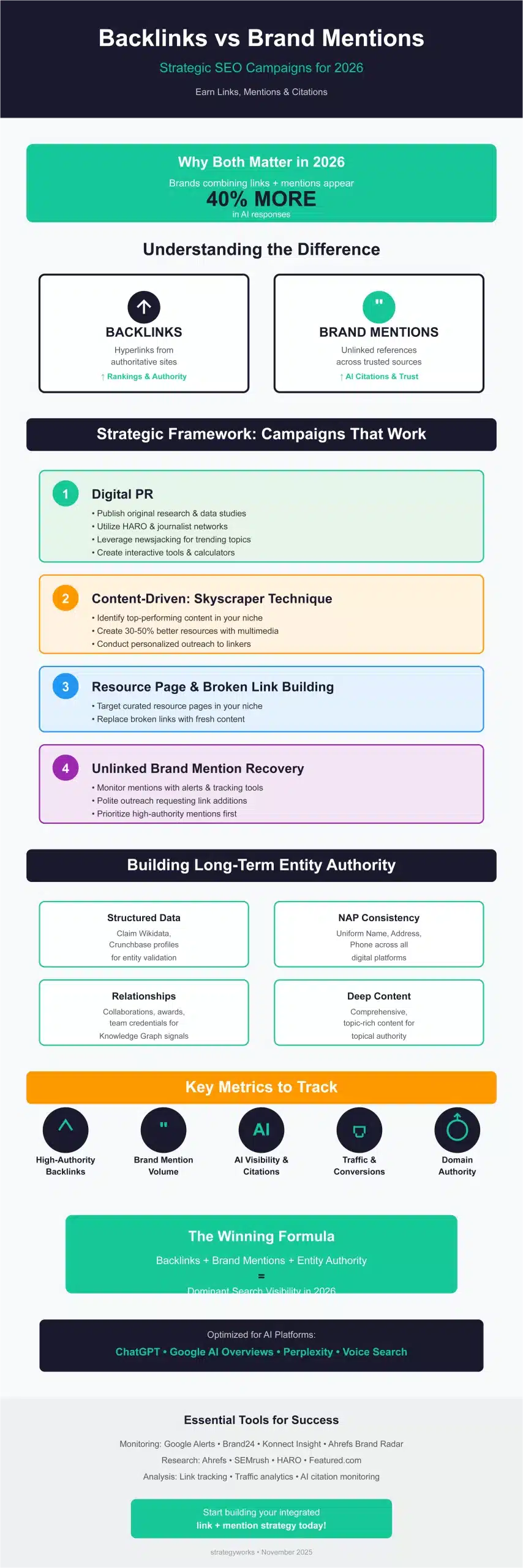
Backlinks vs. Brand Mentions: Earn Links, Mentions & Citations with Strategic Campaigns

Backlinks vs Brand Mentions 2026

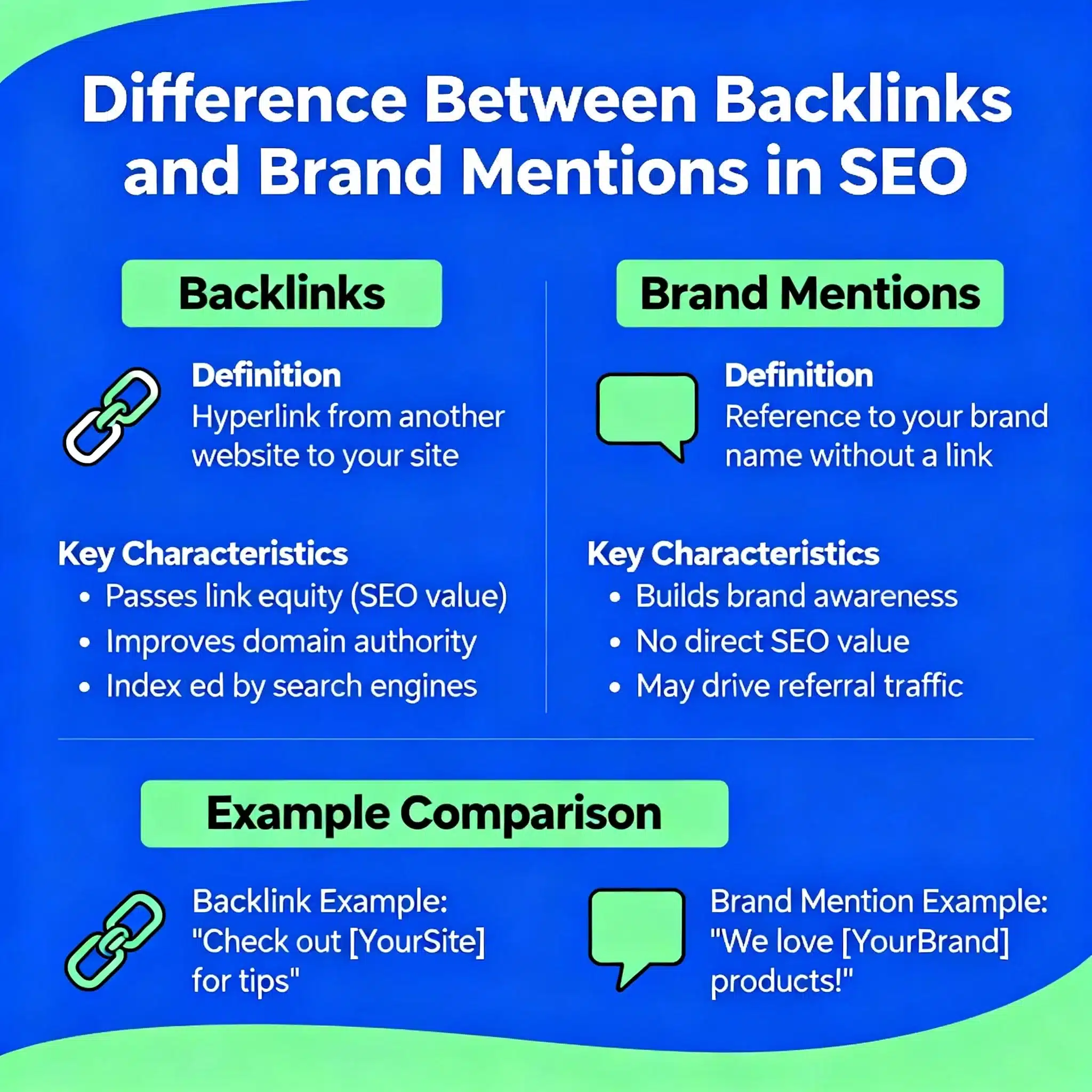
The SEO landscape is evolving beyond traditional link-building. Backlinks remain essential for domain authority, but brand mentions—unlinked references to your brand—have surged in importance, especially with Google’s AI-powered entity-based search. Learn how to integrate both for lasting search visibility.

  • Backlinks: Hyperlinks from authoritative websites that pass “link equity” boosting your rankings.
  • Brand Mentions: Qualitative references to your brand without links that build trust and AI recognition.

Both are essential: backlinks directly impact rankings, while mentions influence AI citations and advanced semantic search.

The AI Search Revolution: Why Brand Mentions Now Matter More Than Ever

AI platforms like ChatGPT, Google AI Overviews, and Perplexity prioritize brands referenced across trusted sources. Brands combining links and mentions appear 40% more often in AI responses, gaining a competitive edge in zero-click and voice search queries.

Digital PR: Your Foundation for Success

Digital PR in 2026 is a strategic mastery of storytelling, data, and relationships to earn authoritative backlinks and brand mentions naturally. Key tactics include:

  • Publish Original Research: Conduct unique surveys, data studies, or reports that become go-to industry references. These generate natural backlinks and mentions, especially when paired with shareable visuals like infographics.
  • Utilize HARO and Journalist Networks: Platforms like HARO , featured.com connect you with journalists seeking expert commentary. By providing timely, insightful input, you earn high-quality mentions and backlinks in reputable media.
  • Leverage Newsjacking: Monitor emerging news and tie your brand’s expert perspective to trending topics quickly. This increases your chances of media coverage and backlinks due to the amplified search interest.
  • Create Interactive Tools and Calculators: Develop practical assets (calculators, quizzes, widgets) that solve user problems, attracting natural backlinks and widespread sharing.

Content-Driven Link Building: The Skyscraper Technique

  • Identify Top-Performing Content: Use tools like Ahrefs or SEMrush to spot content in your niche with significant backlinks.
  • Create Superior Resources: Develop deeper, updated, and multimedia-enhanced content that offers 30-50% more value than existing top content.
  • Conduct Personalized Outreach: Reach out to sites linking to competitors with customized pitches explaining why your content is a better resource, inspiring them to link to you instead.

Resource Page & Broken Link Building

  • Target Curated Resource Pages: Search for resource pages related to your niche using specific operators (e.g., “inurl:resources [topic]“). Offer your content as a valuable addition.
  • Replace Broken Links: Utilize tools to find broken links on authoritative pages and pitch your fresh content as a replacement, helping webmasters maintain quality while gaining backlinks.

Unlinked Brand Mention Recovery

  • Monitor Mentions: Set up alerts with Google Alerts, brand24, Konnect Insight, or Ahrefs Brand Radar to find where your brand is mentioned without a link.
  • Polite Outreach: Contact website owners thanking them for the mention and respectfully request link additions to improve reader experience.
  • Prioritize High-Authority Mentions: Focus on converting mentions from top-tier domains first for maximum SEO benefit.

Building Long-Term Entity Authority

  • Claim Structured Data: Register and optimize your brand’s presence on authoritative databases like Wikidata and Crunchbase to validate entity signals.
  • Maintain Consistent Business Info: Ensure your Name, Address, and Phone details are uniform across all digital platforms.
  • Build Documented Relationships: Establish collaborations, earn awards, and showcase team credentials to strengthen your brand’s contextual relevance in Google’s Knowledge Graph.
  • Publish Comprehensive, Deep Content: Consistently produce topic-rich content to build topical authority and gain search engine favor.

Measuring Success: Key Metrics to Track Backlinks vs Brand Mentions

  • High-Authority Backlinks: Monitor growth in backlinks from trusted, relevant domains.
  • Brand Mention Volume & Sentiment: Track quantity and context of mentions to gauge reputation.
  • AI Visibility: Use specialized tools to measure citations from AI platforms like ChatGPT and Google AI Overviews.
  • Traffic & Conversions: Analyze referral traffic tied to link sources and related conversion rates.
  • Domain Authority: Watch progression of overall site authority indicating campaign effectiveness.

Get a FREE Link Building Audit and personalized campaign plan tailored to your brand’s goals.
Contact Us Now

Info Graphics on Backlinks vs Brand Mentions

Infographics on Backlinks vs Brand Mentions

Google’s 2025 Algorithm Shift: Why User Behavior, Not AI, Now Drives Search Rankings

The future of SEO isn’t merely about artificial intelligence—it’s about human behavior. Liz Reid, Google’s VP and head of Search, recently told the Wall Street Journal’s Bold Names and Search Engine Land that younger audiences increasingly prefer short-form video, forums, and creator-led content over traditional webpages.

Reid explained, “We’re seeing a shift in who people go to for answers—they’re turning to short-form video, forums, and user-generated content a lot more than conventional sites.”

This user-driven evolution is reshaping how Google ranks content, rewarding creators and communities that deliver authentic value over technical precision.

Understanding Google’s 2025 Updates

Google’s June Core and August Spam Updates of 2025 confirm that the search engine is aligning its algorithms with user intent, experience, and credibility.

  • June 2025 Core Update: Elevated sites with multimedia assets and niche authority, rewarding platforms like YouTube, Wikipedia, and specialist blogs.
  • August 2025 Spam Update: Penalized “parasite SEO,” thin AI content, and template-heavy or duplicated pages.

According to analyses by leading SEO strategists, sites that excelled shared three traits—authentic expertise, multimedia storytelling, and clean information architecture.

What Google Now Prioritizes (2025 Ranking Signals)

The new algorithmic emphasis revolves around trust and human experience rather than mechanical keyword patterns.

Key Quality Signals:

  • Depth and authenticity: Human-written, experience-based insights outperform generic AI text.
  • Multimedia integration: Videos, podcasts, visuals, and case studies increase dwell time—a ranking factor Google associates with “rich content.”
  • E-E-A-T validation: Clear author credentials, expert bios, and original research build authority and visibility.
  • User satisfaction metrics: Google tracks bounce clicks—when visitors quickly backtrack—to gauge whether content meets expectations.

Why Short-Form and UGC Dominate Rankings

Younger internet users no longer start their searches on traditional sites. They look to YouTube Shorts, Reddit threads, Quora answers, and TikTok explainers.

Google is adapting accordingly. Its ranking system increasingly highlights content that feels interpersonal, experience-driven, and accessible over institutional sources.

Platforms like YouTube gained over 300 visibility points after the June update—an unprecedented leap. This shows a clear trend: visual and participatory content is now integral to search performance.

Optimization Tactics for 2025:

  • Repurpose blogs into micro-video explainers or summary reels.
  • Add comment and discussion sections to encourage peer exchange.
  • Optimize video captions, chapters, and metadata to integrate with Google’s AI indexing.
  • Encourage authentic UGC contributions like testimonials, Q&As, or case-based narratives

SpamBrain, Experience, and Low-Value Content

Google’s SpamBrain AI engine continues to evolve, identifying patterns of content abuse such as doorway pages, duplicate location posts, or mass-produced AI text.

However, Reid clarified that “AI itself isn’t the problem—low-value output is.” Google’s objective is to elevate nuanced, experiential writing over scaled, repetitive articles.

What to Avoid:

  • Thin machine-generated pages with little topical value.
  • Expired domain exploitation (repurposing irrelevant old domains).
  • Affiliate-style content lacking credible context or originality.

Sites that demonstrate editorial control and human involvement are now consistently outperforming automated content farms.

The Rise of “Search Experience Optimization” (SXO)

SEO in 2025 is moving beyond technical compliance toward Search Experience Optimization (SXO)—a holistic strategy that merges user psychology, UX design, and semantic SEO.

SXO Core Principles:

  1. Speed and accessibility: Core Web Vitals remain non-negotiable.
  2. Scannable storytelling: Use bullet lists, rich snippets, and responsive layouts.
  3. Topic cluster depth: Build authority around broader search intents, not isolated keywords.
  4. Intent-based multimedia: Pair video, visuals, and explainer text around one query.
  5. Trust layering: Highlight reviews, accreditations, and fact-checked sources.

Embedding these signals in your site architecture helps future-proof performance amid SERP volatility.

How Publishers Should Adapt

Reid emphasized that Google still “cares deeply about the health of the open web” , but the definition of “open” now includes participatory formats. Publishers and brands must therefore blend long-form authority with community interaction.

  • Reinforce Your Author Network: Add detailed author bios, citations, and source references.
  • Audit Thin Pages: Merge or remove repetitive subpages targeting minor keyword variations.
  • Invest in Video and Podcasts: Complement every cornerstone article with embedded visuals.
  • Experiment with Forums: Create moderated forums or “Ask an Expert” verticals to simulate user-generated interaction.
  • Structure for AI Overviews: Use schema for FAQs and VideoObject to appear in AI summaries.

Winners & Losers: Lessons from the June 2025 Core Update

Winners:

  • YouTube, Wikipedia, and niche educational sites saw visibility surges through original research and video integration.
  • Longstanding hobbyist blogs thrived due to passion-driven storytelling and authentic expertise.

Losers:

  • Large e-commerce networks and AI-content-heavy sites.
  • Platforms with scaled, cookie-cutter location or review pages.
  • Even LinkedIn saw visibility dips in certain keyword categories due to repetitive content structures

Adaptation Framework – 7-Step SXO Action Plan

  1. Audit duplicate or templated pages post-update.
  2. Add firsthand insight—case studies, testimonials, and mini-stories.
  3. Enhance multimedia depth: images, summaries, charts, or videos within each content hub.
  4. Publish authorship & trust signals visibly on every page.
  5. Implement structured data for Articles, FAQs, and Videos to reinforce machine understanding.
  6. Track behavioral data like dwell time and micro-interactions instead of keyword density.
  7. Update and republish quarterly to maintain freshness in dynamic industries.

Reid’s statements underscore that search success depends more on adaptive storytelling than technical compliance. Google’s algorithms no longer reward volume—they reward verifiable originality and engagement.

As AI-generated summaries and intuitive search grow, brands that deliver real voices, community energy, and entity-level authority will stand out.

The question for every marketer now becomes:
Are you optimizing for Google—or for the people who teach Google what to value?

Key Takeaways

  • Google’s ranking model increasingly reflects how users prefer to learn—via short-form video, community interaction, and credible human commentary.
  • The June 2025 Core Update rewarded multimedia and niche authority, while the August Spam Update deindexed mass-produced AI or templated pages.
  • Focus your 2025 SEO around E-E-A-Tauthentic voices, and SXO design principles.
  • Future-proof strategies combine content depth with behavioral empathy—meeting users where they already are.

Is your site ready for behavioral search? Get a 2025 SXO and content Checklist from Strategyworks — and learn how to future-proof your rankings while visibility shifts toward creators.

Download FREE- SEO Expert Daily Reference Checklist

WordPress Alternatives Guide : Why Users Are Switching & Which Platform Fits You Best

WordPress Alternatives

Is WordPress holding your website back?

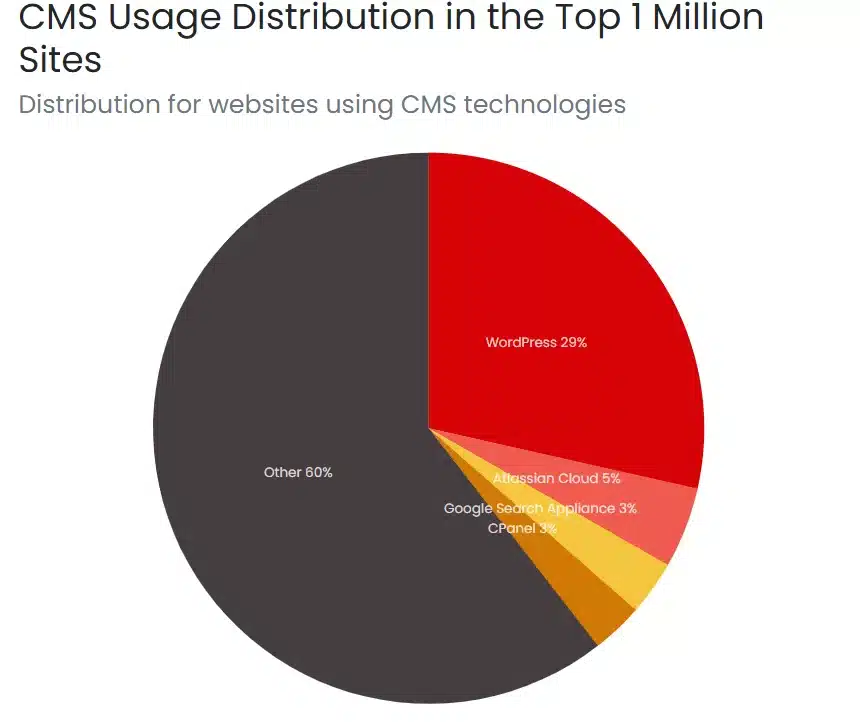
In 2025, over 43% of all websites still run on WordPress—but frustration is growing. From constant plugin updates to major security flaws, today’s businesses are asking: “are there any better WordPress Alternatives ?”

According to builtwith.com

Digital marketing case study for sustainability company image

This guide breaks down why users are moving away from WordPress, the best modern alternatives, and how to migrate without losing SEO rankings.

Why Businesses Are Leaving WordPress

Security Risks
  • 70% of WordPress sites are vulnerable to attacks (due to outdated plugins/themes; we have seen around 85% or more of our cutomers they never update their plugins and themes and almost all the websites get in to troubles in years time).
  • Common threats: malware injections, brute force hacks, SQL injections.
Maintenance Headaches
  • Daily/weekly updates required.
  • Plugins frequently break sites during updates.
  • Community forums offer no guaranteed support.
Performance Bottlenecks
  • Each plugin slows down page load speed( more plugins/codes on site will kill the speed of the website, no spped optimization tool can make it faster)
  • Poor Core Web Vitals = lost Google rankings( The biggest problem with WordPress)
Scalability Issues
  • As websites grow, performance dips and costs rise.
  • Requires expensive hosting + custom developer support.( the cost of a custom wordpress development is very high and also the cost of a wordpress developer)
Limited Support
  • No direct customer service—only forums and community goodwill.

The Best WordPress Alternatives

To make it easier, here’s a comparison snapshot:

PlatformBest ForPricingAdvantage over WPExample Users
SanityContent teams$15/userReal-time collaborationEurostar, InVision
Payload CMSDevelopersFree OSFull code-first controlMicrosoft, ASICS
GhostCreators/Publishers$9–199Built for monetized blogsUnsplash, Buffer
DrupalEnterprises/GovFree+Security & multilingualWhite House, The Economist
JoomlaMid-sized businessesFree+More built-in featuresForums, NGOs
WixSmall businesses$17–159No hosting neededSMBs worldwide
WebflowDesigners/agencies$14–39Visual drag‑drop + hostingFreelancers, Startups
ShopifyE-commerce$29–2000+Sales-first architecture1M+ merchants
HubSpot Content HubB2B marketers$15+CRM + lead gen integratedSaaS, Enterprise
DivhuntMid-sized businessesFree+Visual drag‑drop + hostingProfessional websites
OxygenCreators/Publishers$ 199.50 (Liftime Bundle)Visual drag‑drop + hostingSMBs worldwide

Which WordPress Alternatives Is Right for You?

Choose a Headless CMS (Sanity, Payload, Directus) if:

  • You want scalability + multi-channel delivery (apps, IoT, web).
  • Dev team is comfortable with APIs + code.
Headless CMS

Choose a Website Builder (Wix, Webflow, Hostinger) if:

  • You need fast setup, modern design, no maintenance.
  • You’re a small business or freelancer.

Choose E-Commerce Platforms (Shopify, BigCommerce) if:

  • Your primary business is online sales.
  • You need advanced checkout flows + marketing tools.

Choose Drupal / Joomla if:

  • You run government, NGO, or enterprise-level projects.
  • Priorities = security + multilingual capability.

Migration Made Simple: SEO-Safe Steps

Step 1. Audit Your Site

  • List all pages, URLs, traffic sources.( The best Tools to do the site audit are semrush.com, ahrefs.com, seoptimer.com or any other simillar tools can be used)

Read: The Ultimate Guide to Free AI Marketing Tools for Higher ROI

Step 2. Create Redirect Map (301s)

  • Preserve SEO rankings. ( if you are using rankmath plugin then redirection is included in free plan and if using yoast, the use Redirection Plugin )

Step 3. Backup & Migrate

  • Use platform migration tools or hire experts.

Step 4. Submit New Sitemap

  • Google Search Console update.

Step 5. Test Performance & Core Web Vitals

  • Ensure improved speed + UX post-migration.

WordPress vs Alternatives: The Real Costs

WordPress Costs (Annual Est.):

  • Hosting: $60–$600
  • Plugins & themes: $200–500+
  • Security tools: $100–300
  • Developer/maintenance: $2,000–5,000
    Total: $2,000–8,000 per year

Alternatives (Annual Est.):

  • Wix/Webflow: $168–1,900 (all-in-one, zero maintenance)
  • Shopify: $348–27,600 (depends on scale)
  • Sanity / Ghost / Drupal: Lower recurring costs, higher dev costs upfront

Quick Answer: Is WordPress Still Worth It?

WordPress works if:

  • You’re a skilled developer who can handle updates.
  • You’re running a basic blog or portfolio site on a budget.

It’s time to switch if:

  • Security breaches + updates are draining your time.
  • Your site is slow, and Google rankings are falling.
  • You need enterprise-scale performance + support.

FAQs on WordPress Alternatives

Is WordPress obsolete in 2025?

No—but many businesses find faster, more secure options better suited for growth.

What is the best WordPress alternative for SEO?

Webflow and Ghost are strong for SEO, while Sanity & Payload provide future-proof scalability.

Will I lose SEO if I migrate?

Not if you implement 301 redirects, sitemap updates, and structured migration planning.

Is Shopify better than WordPress for e-commerce?

Yes, Shopify is purpose-built for online sales with advanced features out-of-the-box. But it has got its own recurring cost.

Building a Luxury Interior Design Brand with Joby Joseph

luxury interior designer Bangalore
  • Client: Joby Joseph — Premium Interior Designer
  • Industry: Interior Design & Renovation
  • Location: Bangalore, India
  • Duration: 5-6 Months (Ongoing)
  • Services Provided: SEO (On-page & Off-page), Keyword Strategy, Technical SEO Fixes, Content Creation, Authority Building

Client Overview

Joby Joseph is a renowned interior designer known for his work with prestigious clients such as Marriott, Taj Hotels, Infosys, and other high-profile names. As a third-generation design expert, Joby has carried forward a legacy of design excellence with a focus on luxury interiors, celebrity homes, and ethnic design elements.

With an already existing website, Joby approached StrategyWorks to help position his brand more strongly in the digital space, targeting high-end clients and ranking for competitive keywords in the luxury interior design industry.

The Business Problem

Despite having an impressive portfolio featuring high-end projects for names like Marriott, Taj, and Infosys, Joby Joseph’s online presence was nearly invisible.

The Core Issue:

His brand wasn’t discoverable on Google. The website lacked visibility for crucial keywords. As a result, premium clients searching for luxury interior designers in Bangalore weren’t finding him.

This low discoverability directly impacted his bottom line – fewer inbound leads, reduced project inquiries, and missed business opportunities in a market where buyers start their journey online.

Our Objective

  • Position Joby Joseph among the top luxury interior designers in Bangalore
  • Drive high-quality, organic traffic through Google search
  • Generate consistent inquiries from qualified, premium clients—without paid advertising

Our Strategic Solution

Our approach focused on fixing the foundation first, followed by targeted growth tactics. Here’s what we executed:

1. SEO Audit & Technical Fixes

Tools used: Google Search Console, Ahrefs, semrush

  • Resolved crawl errors and redirects for seamless Google indexing
  • Enhanced mobile responsiveness and site speed (both crucial for user experience and SEO)
  • Reindexed all priority service and project pages

2. Targeted Keyword Strategy

Tools used: SEMrush, Google Keyword Planner

luxury interior designer Bangalore

We mapped 120+ high-volume keywords aligned with luxury interior services:

  • Luxury interior designers in Bangalore
  • Builders of luxury homes
  • Temple architecture
  • Home renovation services in Bangalore
  • Interior design consultation services

3. On-Page Optimization

  • Optimized meta titles, H1s, image ALT tags
  • Created internal linking between service and blog pages
  • Restructured URLs for SEO and user clarity

4. Authority Building via Off-Page SEO

Tools used: Ahrefs, Moz Link Explorer

  • Earned high-value backlinks from top interior design publications and regional directories
  • Secured listings on premium local business platforms (Google My Business, JustDial, Sulekha, Houzz)
  • Conducted targeted PR outreach for brand mentions and authority signals

5. Content Creation & Publications

https://jjinteriordesigns.com/blog

  • Developed SEO-rich blogs to target commercial (e.g., interior design pricing Bangalore) and informational (e.g., modern minimalist luxury home tips) keywords
  • Blog topic list:
    • Interior Design Price in Bangalore
    • Modern Minimalist Design for Luxury Homes
    • Temple Architecture in Modern Villas
  • Facilitated publication placements in niche media and blog features

Measurable Results: Impact on the Bottom Line

MetricBeforeAfter 5-6 MonthsGrowth
Organic Keywords Ranking    10120+🔼 12x increase
Google Rank – ‘Temple Architecture’  Not in Top 100#1 Position
Rank – ‘Builders of Luxury Homes’NA#5 Position
Organic Website TrafficLow⬆ Significant Growth📈
Lead Inquiries (Premium Clients)OccasionalWeekly Inquiries from Architects, Hoteliers🎯

ROI Estimate:
The SEO campaign was executed within a modest budget, and the client started receiving qualified leads without spending on paid media. Cost per lead dropped significantly, while brand value increased.

🗣️ Client Testimonial

StrategyWorks helped us break through online noise. The quality and frequency of project inquiries have truly transformed our business.
Joby Joseph, Interior Designer

🧰 Tools Used Throughout the Project

  • Google Search Console
  • SEMrush
  • Ahrefs
  • WordPress
  • Rank Math
  • Screaming Frog
  • Google Analytics
  • Canva (for content design)

This project demonstrates how SEO done right with technical precision, targeted content, and brand positioning can generate tangible business results. In just under six months, Joby Joseph’s brand went from invisible to influential, now ranking for premium keywords and engaging the exact audience he wanted.

Need Results Like This?

We specialise in turning businesses with potential into brands with performance. If you’re looking to attract high-ticket clients and grow online — let’s talk. Also if you based in San Jose, USA and owning ainterior design firm, see thi spage: Digital Marketing for Interior Designers San Jose

Strategyworks Chatbotx
Chatbot