
AI tools are now part of almost every creator workflow.
From AI thumbnails and scripts to AI B-roll, AI voice cleanup, cinematic visuals, and generative editing plugins — creators everywhere are using artificial intelligence in some form.
But ever since YouTube introduced mandatory AI disclosure rules, one question keeps appearing across Reddit, creator forums, Discord communities, and YouTube groups:
“Do I actually need to disclose AI usage on my videos?”
The confusion is understandable.
Many creators believe:
- any AI usage requires disclosure,
- AI automatically hurts monetization,
- or YouTube penalizes AI-assisted content.
None of that is entirely accurate.
This guide breaks down what YouTube’s AI disclosure policy actually means, what creators on Reddit are discussing, and when you really need to check the “AI-generated content” box.
Why YouTube AI Disclosure Rules introduced?
According to YouTube, the goal is transparency — not banning AI.
The platform wants viewers to know when content they are watching may appear realistic but was actually generated or altered using AI.
This became especially important after the rise of:
- deepfakes,
- fake celebrity videos,
- AI-generated news footage,
- synthetic interviews,
- fake political speeches,
- and realistic AI-generated events.
YouTube officially requires creators to disclose content that is:
- “meaningfully altered,”
- “synthetically generated,”
- and realistic enough to potentially mislead viewers.
The Biggest Misunderstanding About YouTube’s AI Policy
Most creators think:
“If AI touched my workflow, I must disclose it.”
That is NOT what the policy says.
YouTube repeatedly clarifies that:
- production assistance,
- editing help,
- script generation,
- thumbnails,
- captions,
- voice cleanup,
- upscaling,
- and many normal editing workflows do NOT require disclosure.
The real trigger is this:
Could viewers mistake the AI content for reality?
If yes → disclosure is likely required.
If no → probably not.
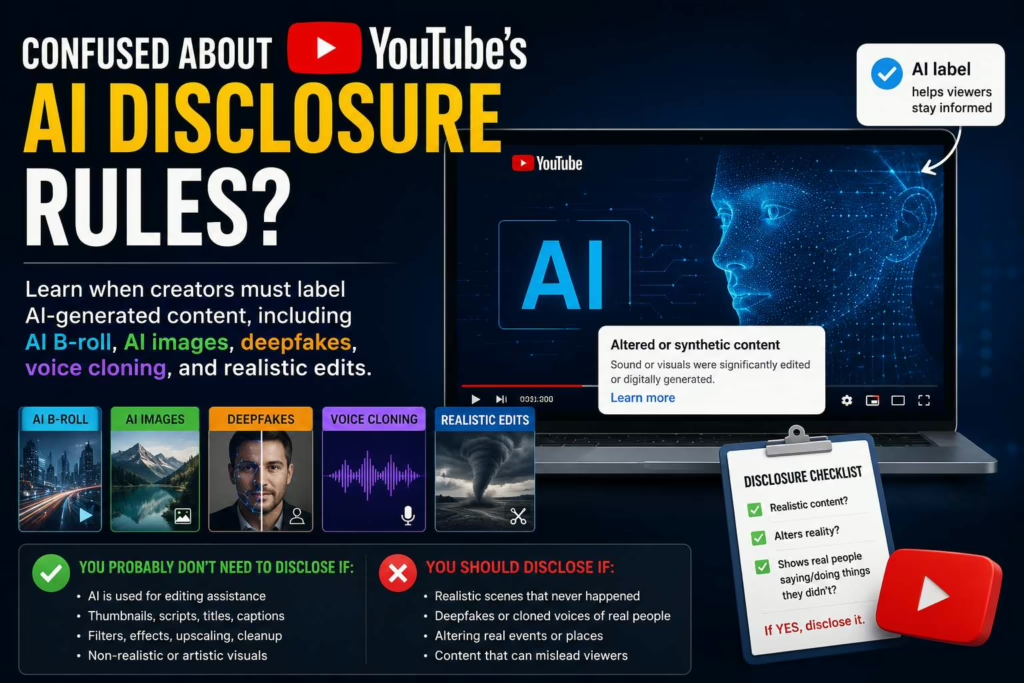
What Usually DOES NOT Require Disclosure
Most everyday creator workflows are safe.
Examples include:
- AI-generated thumbnails
- AI-assisted scripts
- AI title generation
- AI-generated infographics
- AI voice enhancement
- audio cleanup
- color grading
- cinematic effects
- background blur
- AI upscaling
- AI-generated abstract visuals
- fantasy scenes
- stylized animations
- AI-generated mood B-roll
- AI-generated concept art
Even YouTube explicitly says production assistance generally does not require disclosure.
This is why many:
- faceless channels,
- educational channels,
- marketing creators,
- agency owners,
- and podcast editors
are already using AI-enhanced workflows without labeling every video as AI-generated.
What DOES Require Disclosure
You should disclose when AI creates or alters realistic content in a way that could deceive viewers.
Examples:
- fake interviews,
- AI celebrity speech,
- fake arrests,
- fabricated disaster footage,
- synthetic war footage,
- AI-generated “real” events,
- fake sports footage,
- or making someone appear to say something they never said.
YouTube specifically highlights:
- altered real events,
- fake realistic scenes,
- and impersonation-style content.
The Question Most Creators Are Asking Right Now
“What if I use AI-generated B-roll?”
This is probably the most common creator question in 2026.
Many editors now use:
- DaVinci Resolve plugins,
- Runway,
- Pika,
- Veo,
- Midjourney images,
- Kling,
- Sora-style tools,
- or AI-enhanced stock workflows.
Often:
- 90% of the video is real,
- while 1–2 supporting visuals are AI-generated.
So does that require disclosure?
Usually: No.
If the AI visuals are:
- illustrative,
- cinematic,
- conceptual,
- brief,
- obviously artistic,
- or not pretending to document reality,
then creators generally do not need disclosure.
This matches how most creator communities are interpreting the rule today.
What Reddit Creators Are Saying
Across Reddit creator communities, most discussions point toward the same interpretation:
The overall creator consensus seems to be:
AI as an editing assistant is usually fine.
But:
AI pretending to be reality is where disclosure becomes necessary.
Can YouTube Detect AI automatically?
Increasingly, yes.
YouTube now uses:
- internal AI detection systems,
- metadata systems like C2PA,
- and AI-origin detection signals.
The platform can also:
- manually add labels,
- or penalize repeated non-disclosure for realistic deceptive AI content.
However, YouTube also says:
- AI labels do not directly affect monetization,
- recommendations,
- or audience reach.
Will AI Disclosure Hurt Your Channel?
This is another major fear among creators.
Research and creator observations suggest the impact is often psychological rather than algorithmic.
A recent study on AI disclosure found that disclosure generally had little effect on audience evaluation except in highly emotional or deeply human content categories.
YouTube itself states disclosure labels are meant for transparency, not punishment.
A Simple Rule Every Creator Can Use
Ask yourself:
“Could viewers believe this actually happened?”
If yes:
→ disclose.
If no:
→ you’re probably fine.
Practical Examples
Usually No Disclosure Needed
- AI-generated cinematic city B-roll
- AI concept visuals
- AI fantasy backgrounds
- AI-generated infographic animations
- AI-enhanced editing
- AI thumbnail generation
- AI audio cleanup
- AI-generated transitions
- AI-generated stock-style visuals
Usually Disclosure Needed
- Fake celebrity interviews
- Fake political speeches
- AI-generated disaster footage
- Synthetic documentary scenes
- Fake news visuals
- AI-generated “real event” footage
- Deepfake impersonations
Final Thoughts
AI is no longer a niche creator tool.
It is becoming part of:
- editing,
- scripting,
- design,
- voice processing,
- thumbnails,
- B-roll creation,
- and production workflows everywhere.
YouTube’s policy is not trying to ban AI-assisted creativity.
The platform is primarily targeting:
- deception,
- misinformation,
- impersonation,
- and realistic fake media.
For most creators using AI as:
- a creative assistant,
- a visual enhancer,
- or a production tool,
there is usually no need to panic about disclosure.
The safest long-term strategy is simple:
Use AI creatively.
Avoid misleading realism.
Disclose when realism could deceive.